2027

ReGraph3D: Lightweight Language-Guided 3D Indoor Scene Rearrangement
Gregorio Iturralde, Michael Ying Yang, Yao Wei
Under review. 2027
We introduce ReGraph3D, a lightweight framework for language-guided 3D indoor scene rearrangement. We further introduce BSSG-FRONT, extending SSR-3DFRONT with relational scene graphs for 14,992 indoor scenes. ReGraph3D achieves over 90% accuracy for directional spatial relations and performs pose generation with only 1.44M parameters in approximately 0.04 seconds per scene.
ReGraph3D: Lightweight Language-Guided 3D Indoor Scene Rearrangement
Gregorio Iturralde, Michael Ying Yang, Yao Wei
Under review. 2027
We introduce ReGraph3D, a lightweight framework for language-guided 3D indoor scene rearrangement. We further introduce BSSG-FRONT, extending SSR-3DFRONT with relational scene graphs for 14,992 indoor scenes. ReGraph3D achieves over 90% accuracy for directional spatial relations and performs pose generation with only 1.44M parameters in approximately 0.04 seconds per scene.
GraphVSelect: Verified Graph-guided Selection for Zero-shot Referring Expression Comprehension
Jeonghyun Choi, Yao Wei, Hyungcheol Noh, Andrea Cavallaro, Changjae Oh
Under review. 2027
We present GraphVSelect, a training-free zero-shot REC framework that verifies candidates before query-conditioned graph construction, jointly ranks them under relational context, and re-examines ambiguous predictions, yielding relative gains of 15.0% on RefCOCO/+/g and 16.6% on Ref-L4 over the strongest baseline.
GraphVSelect: Verified Graph-guided Selection for Zero-shot Referring Expression Comprehension
Jeonghyun Choi, Yao Wei, Hyungcheol Noh, Andrea Cavallaro, Changjae Oh
Under review. 2027
We present GraphVSelect, a training-free zero-shot REC framework that verifies candidates before query-conditioned graph construction, jointly ranks them under relational context, and re-examines ambiguous predictions, yielding relative gains of 15.0% on RefCOCO/+/g and 16.6% on Ref-L4 over the strongest baseline.
FlowOVD: Learning Generative Latent Flows for Zero-shot Open-vocabulary Detection
Yao Wei, Andrea Cavallaro, Changjae Oh
Under review. 2027
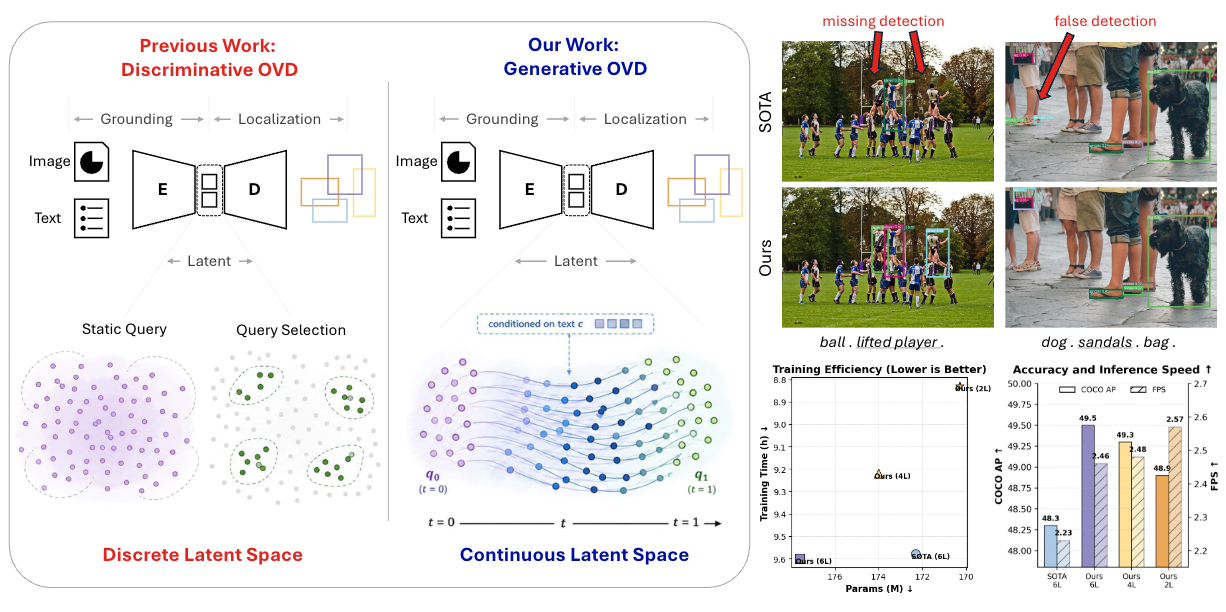
We propose FlowOVD, a text-conditioned query generation framework based on rectified flow that progressively transforms text-agnostic queries into text-guided queries. By introducing continuous latent query dynamics into a vision-language model (VLM) based detector, our method avoids heuristic discrete query construction and enables more expressive semantic alignment for open-vocabulary detection. Without requiring additional training data, FlowOVD achieves 49.5 AP on COCO and 31.5 AP on LVIS, outperforming GroundingDINO by +1.2 AP (+2.5 %) and +4.1 AP (+15.0 %), respectively.
FlowOVD: Learning Generative Latent Flows for Zero-shot Open-vocabulary Detection
Yao Wei, Andrea Cavallaro, Changjae Oh
Under review. 2027
We propose FlowOVD, a text-conditioned query generation framework based on rectified flow that progressively transforms text-agnostic queries into text-guided queries. By introducing continuous latent query dynamics into a vision-language model (VLM) based detector, our method avoids heuristic discrete query construction and enables more expressive semantic alignment for open-vocabulary detection. Without requiring additional training data, FlowOVD achieves 49.5 AP on COCO and 31.5 AP on LVIS, outperforming GroundingDINO by +1.2 AP (+2.5 %) and +4.1 AP (+15.0 %), respectively.
2026
AccioScene: Compositional 3D Scene Generation via Graph Diffusion and Interaction-driven Critics
Yao Wei, Matteo Toso, Pietro Morerio, Changjae Oh, Michael Ying Yang, Alessio Del Bue
British Machine Vision Conference (BMVC) 2026
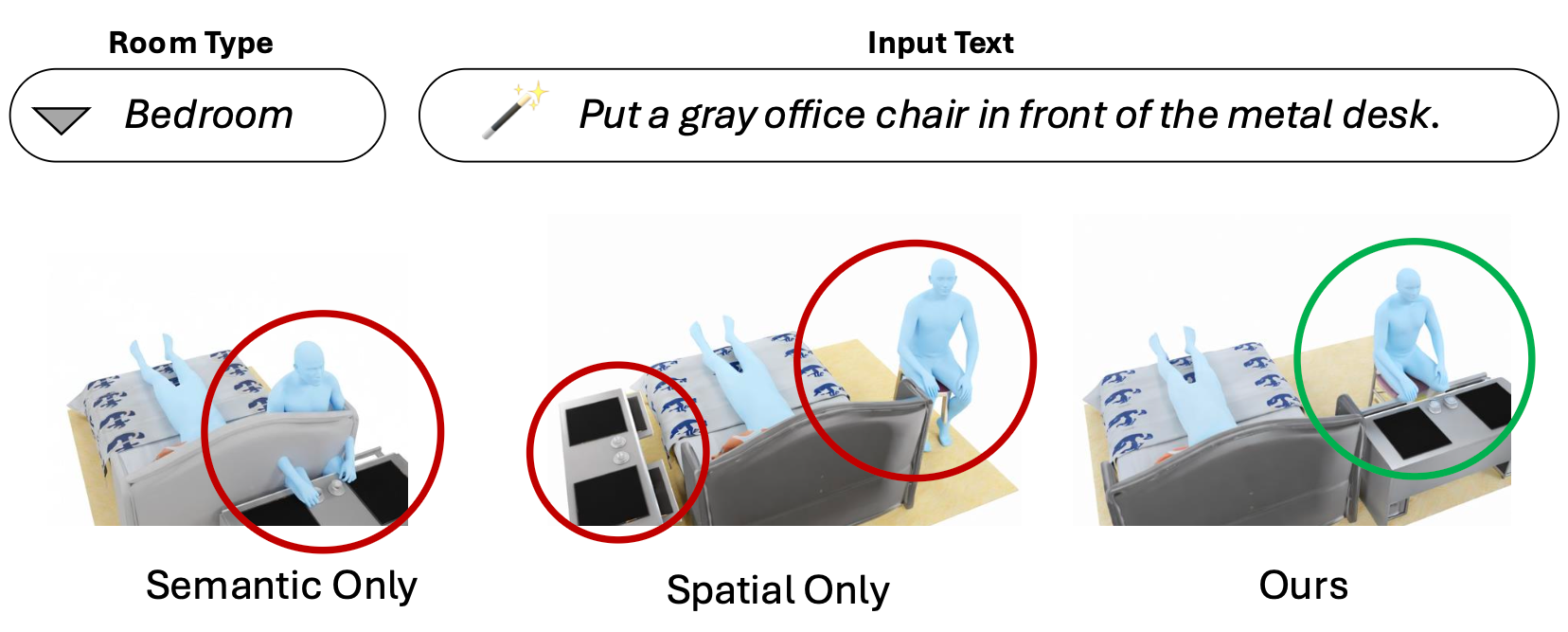
In this paper, we introduce a multi-stage pipeline that better reflects practical scene creation scenarios. Given a text prompt describing partial scene content, our method first uses graph diffusion to produce a contextually coherent scene graph and then predicts a realistic object layout. In addition, we incorporate lightweight human-object interaction priors to encourage human-centric and functional arrangements, with explicit spatial constraints to reduce interpenetration. Our approach generates coherent 3D scenes with viable layouts that better support human interaction.
AccioScene: Compositional 3D Scene Generation via Graph Diffusion and Interaction-driven Critics
Yao Wei, Matteo Toso, Pietro Morerio, Changjae Oh, Michael Ying Yang, Alessio Del Bue
British Machine Vision Conference (BMVC) 2026
In this paper, we introduce a multi-stage pipeline that better reflects practical scene creation scenarios. Given a text prompt describing partial scene content, our method first uses graph diffusion to produce a contextually coherent scene graph and then predicts a realistic object layout. In addition, we incorporate lightweight human-object interaction priors to encourage human-centric and functional arrangements, with explicit spatial constraints to reduce interpenetration. Our approach generates coherent 3D scenes with viable layouts that better support human interaction.
2025
Planner3D: LLM-enhanced Graph Prior Meets 3D Indoor Scene Explicit Regularization
Yao Wei, Martin Renqiang Min, George Vosselman, Li Erran Li, Michael Ying Yang
IEEE Transactions on Pattern Analysis and Machine Intelligence (TPAMI) 2025
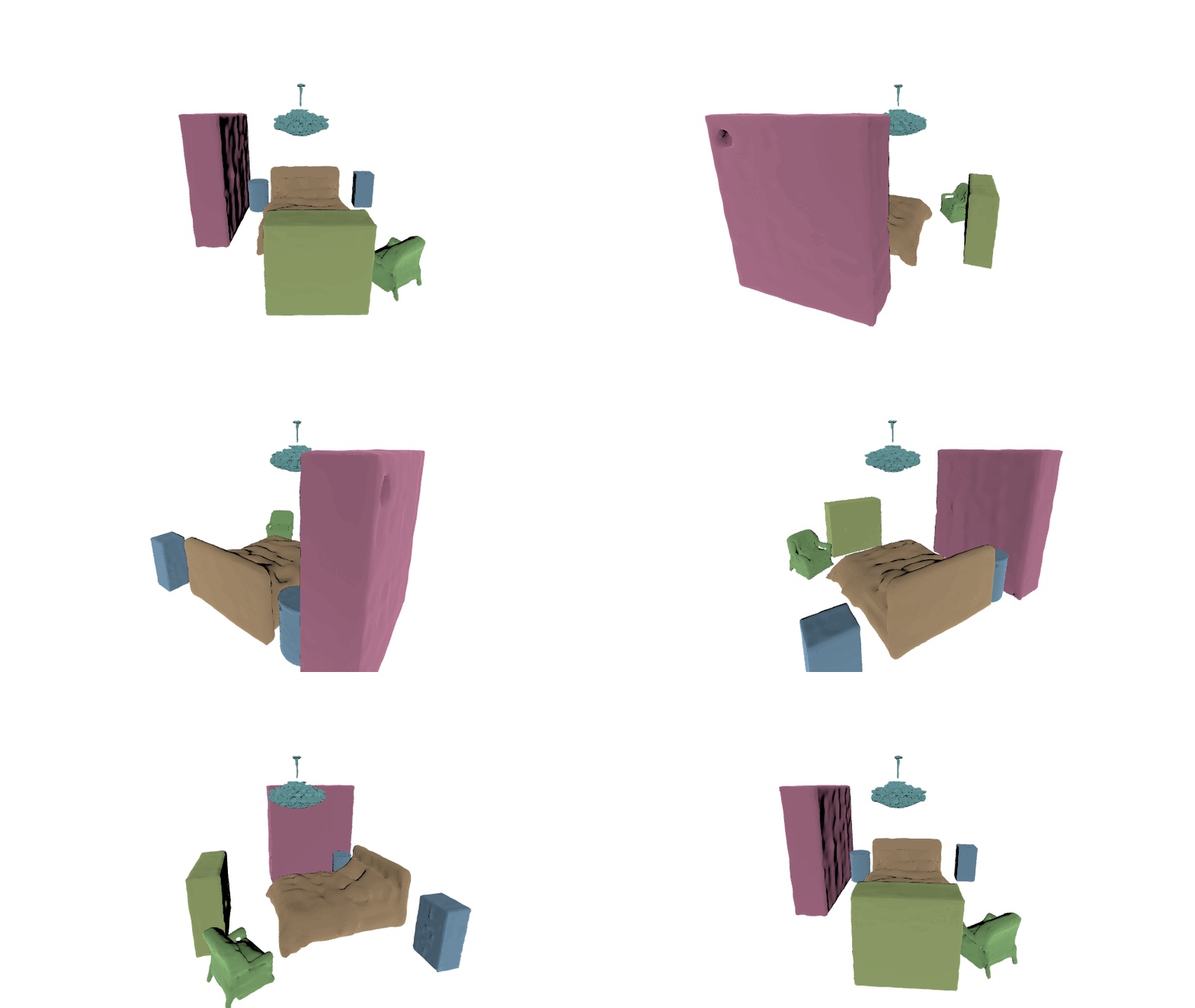
In this paper, we aim at generating realistic and reasonable 3D indoor scenes from scene graph. To enrich the priors of the given scene graph inputs, large language model is utilized to aggregate the global-wise features with local node-wise and edge-wise features. With a unified graph encoder, graph features are extracted to guide joint layout-shape generation. Additional regularization is introduced to explicitly constrain the produced 3D layouts. Benchmarked on the SG-FRONT dataset, our method achieves better 3D scene synthesis, especially in terms of scene-level fidelity.
Planner3D: LLM-enhanced Graph Prior Meets 3D Indoor Scene Explicit Regularization
Yao Wei, Martin Renqiang Min, George Vosselman, Li Erran Li, Michael Ying Yang
IEEE Transactions on Pattern Analysis and Machine Intelligence (TPAMI) 2025
In this paper, we aim at generating realistic and reasonable 3D indoor scenes from scene graph. To enrich the priors of the given scene graph inputs, large language model is utilized to aggregate the global-wise features with local node-wise and edge-wise features. With a unified graph encoder, graph features are extracted to guide joint layout-shape generation. Additional regularization is introduced to explicitly constrain the produced 3D layouts. Benchmarked on the SG-FRONT dataset, our method achieves better 3D scene synthesis, especially in terms of scene-level fidelity.
2023
BuilDiff: 3D Building Shape Generation using Single-Image Conditional Point Cloud Diffusion Models
Yao Wei, George Vosselman, Michael Ying Yang
IEEE/CVF International Conference on Computer Vision Workshops (ICCVW) 2023
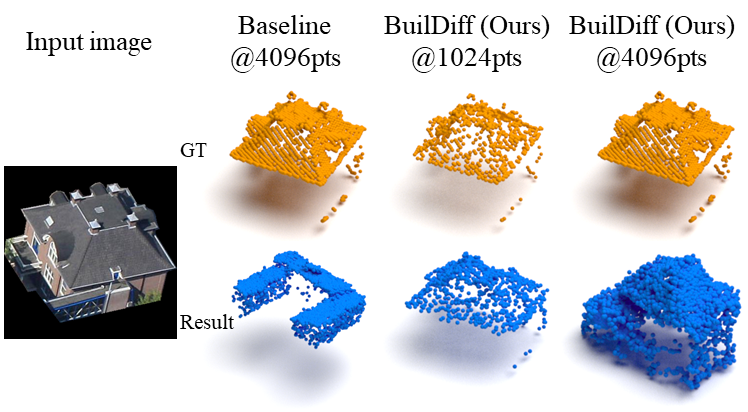
We propose a novel 3D building shape generation method exploiting point cloud diffusion models with image conditioning schemes, which demonstrates flexibility to the input images. By cooperating two conditional diffusion models and introducing a regularization strategy during denoising process, our BuilDiff is able to synthesize building roofs while maintaining the overall structures. We validate our framework on two newly built datasets and extensive experiments show that our method outperforms previous works in terms of building generation quality.
BuilDiff: 3D Building Shape Generation using Single-Image Conditional Point Cloud Diffusion Models
Yao Wei, George Vosselman, Michael Ying Yang
IEEE/CVF International Conference on Computer Vision Workshops (ICCVW) 2023
We propose a novel 3D building shape generation method exploiting point cloud diffusion models with image conditioning schemes, which demonstrates flexibility to the input images. By cooperating two conditional diffusion models and introducing a regularization strategy during denoising process, our BuilDiff is able to synthesize building roofs while maintaining the overall structures. We validate our framework on two newly built datasets and extensive experiments show that our method outperforms previous works in terms of building generation quality.
2022
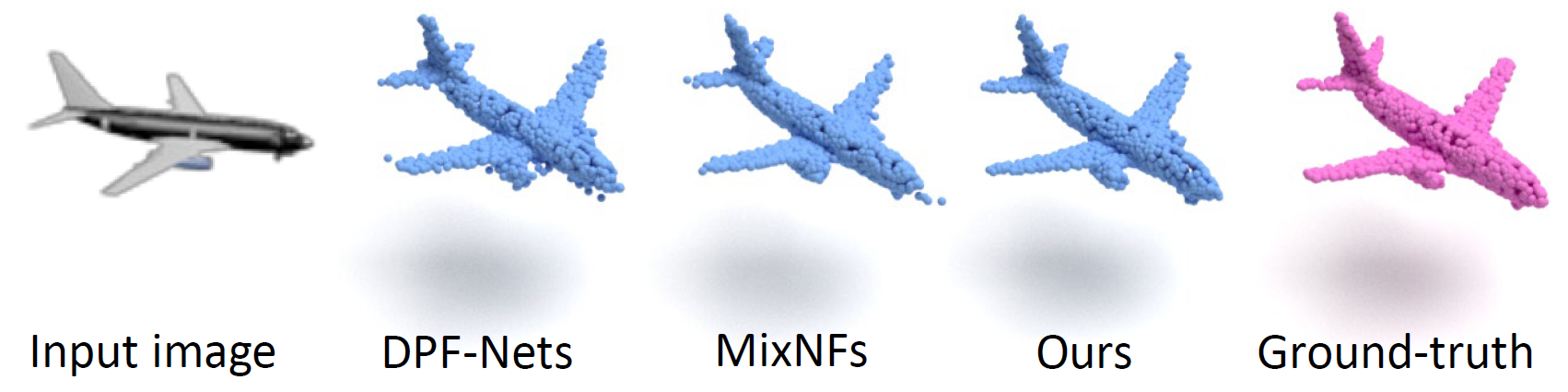
Flow-based GAN for 3D Point Cloud Generation from a Single Image
Yao Wei, George Vosselman, Michael Ying Yang
British Machine Vision Conference (BMVC) 2022
This work introduces a hybrid explicit-implicit generative modeling scheme, which inherits the flow-based explicit generative models for sampling point clouds with arbitrary resolutions while improving the detailed 3D structures of point clouds by leveraging the implicit generative adversarial networks (GANs).
Flow-based GAN for 3D Point Cloud Generation from a Single Image
Yao Wei, George Vosselman, Michael Ying Yang
British Machine Vision Conference (BMVC) 2022
This work introduces a hybrid explicit-implicit generative modeling scheme, which inherits the flow-based explicit generative models for sampling point clouds with arbitrary resolutions while improving the detailed 3D structures of point clouds by leveraging the implicit generative adversarial networks (GANs).
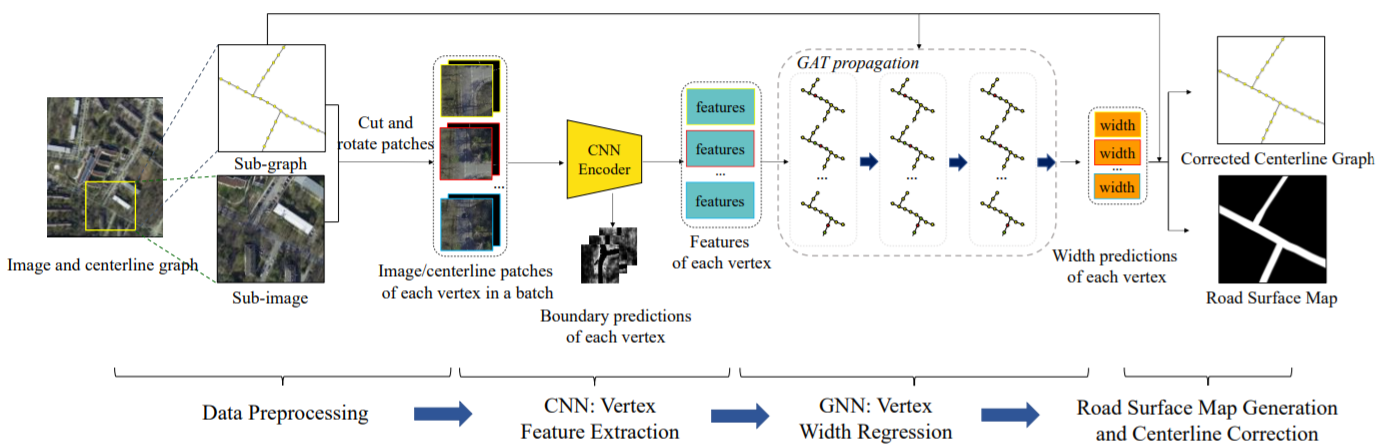
A Combination of Convolutional and Graph Neural Networks for Regularized Road Surface Extraction
Jingjing Yan, Shunping Ji, Yao Wei
IEEE Transactions on Geoscience and Remote Sensing (TGRS) 2022
The proposed method comprehensively outperforms the recent CNN-based segmentation methods and other regularization methods in the intersection over union (IoU) and smoothness score, and a visual check shows that a majority of the prediction results of the proposed method approach the human delineation level.
A Combination of Convolutional and Graph Neural Networks for Regularized Road Surface Extraction
Jingjing Yan, Shunping Ji, Yao Wei
IEEE Transactions on Geoscience and Remote Sensing (TGRS) 2022
The proposed method comprehensively outperforms the recent CNN-based segmentation methods and other regularization methods in the intersection over union (IoU) and smoothness score, and a visual check shows that a majority of the prediction results of the proposed method approach the human delineation level.
2021
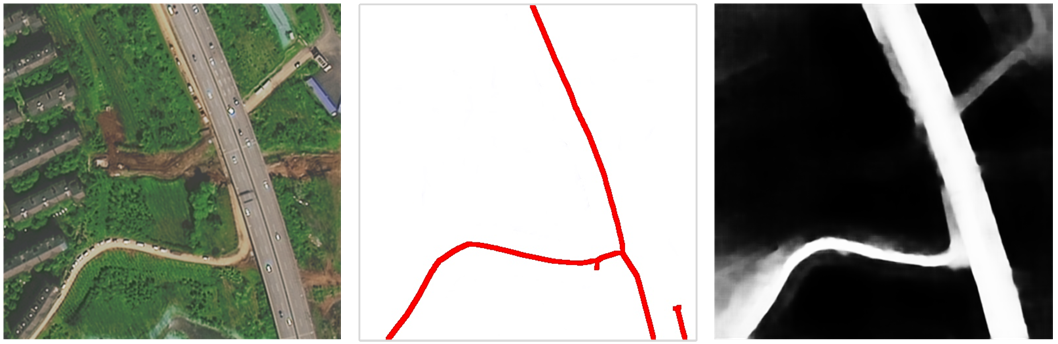
Scribble-based Weakly Supervised Deep Learning for Road Surface Extraction from Remote Sensing Images
Yao Wei, Shunping Ji
IEEE Transactions on Geoscience and Remote Sensing (TGRS) 2021 ESI Highly Cited Paper (Top 1%)
A scribble-based weakly supervised road surface extraction method named ScRoadExtractor, which learns from easily accessible scribbles such as centerlines instead of densely annotated road surface ground truths to propagate semantic information from sparse scribbles to unlabeled pixels. The results demonstrate that ScRoadExtractor exceeds the classic scribble-supervised segmentation method by 20% for the intersection over union (IoU) indicator and outperforms the state-of-the-art scribble-based weakly supervised methods at least 4%.
Scribble-based Weakly Supervised Deep Learning for Road Surface Extraction from Remote Sensing Images
Yao Wei, Shunping Ji
IEEE Transactions on Geoscience and Remote Sensing (TGRS) 2021 ESI Highly Cited Paper (Top 1%)
A scribble-based weakly supervised road surface extraction method named ScRoadExtractor, which learns from easily accessible scribbles such as centerlines instead of densely annotated road surface ground truths to propagate semantic information from sparse scribbles to unlabeled pixels. The results demonstrate that ScRoadExtractor exceeds the classic scribble-supervised segmentation method by 20% for the intersection over union (IoU) indicator and outperforms the state-of-the-art scribble-based weakly supervised methods at least 4%.
2020
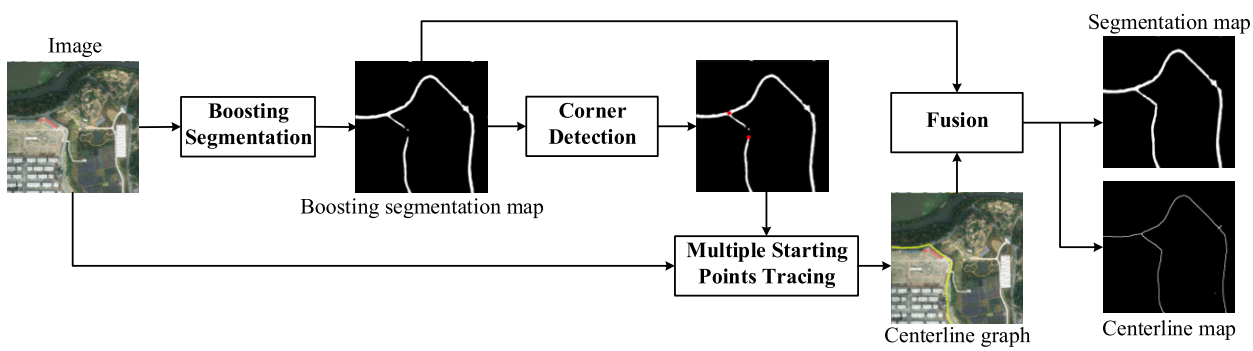
Simultaneous Road Surface and Centerline Extraction From Large-Scale Remote Sensing Images Using CNN-Based Segmentation and Tracing
Yao Wei, Kai Zhang, Shunping Ji
IEEE Transactions on Geoscience and Remote Sensing (TGRS) 2020
This article introduces a novel deep learning-based multistage framework to accurately extract the road surface and road centerline simultaneously and demonstrates the superior performance of the proposed framework. Specifically, our method’s performance exceeded the other methods by 7% and 40% for the connectivity indicator for road surface segmentation and for the completeness indicator for centerline extraction, respectively.
Simultaneous Road Surface and Centerline Extraction From Large-Scale Remote Sensing Images Using CNN-Based Segmentation and Tracing
Yao Wei, Kai Zhang, Shunping Ji
IEEE Transactions on Geoscience and Remote Sensing (TGRS) 2020
This article introduces a novel deep learning-based multistage framework to accurately extract the road surface and road centerline simultaneously and demonstrates the superior performance of the proposed framework. Specifically, our method’s performance exceeded the other methods by 7% and 40% for the connectivity indicator for road surface segmentation and for the completeness indicator for centerline extraction, respectively.
2019
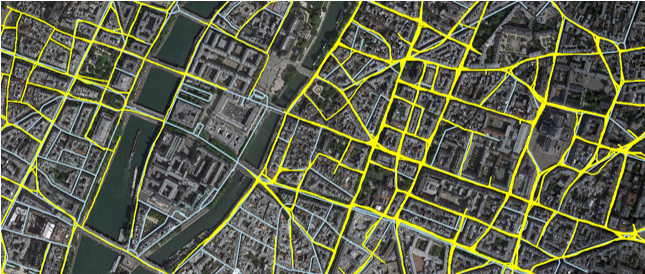
Road Network Extraction from Satellite Images Using CNN Based Segmentation and Tracing
Yao Wei, Kai Zhang, Shunping Ji
IEEE International Geoscience and Remote Sensing Symposium (IGARSS) 2019
This work proposes a multiple starting points tracer which benefits from both segmentation and tracing methods, and finds that this method achieves 8% improvement on IoU.
Road Network Extraction from Satellite Images Using CNN Based Segmentation and Tracing
Yao Wei, Kai Zhang, Shunping Ji
IEEE International Geoscience and Remote Sensing Symposium (IGARSS) 2019
This work proposes a multiple starting points tracer which benefits from both segmentation and tracing methods, and finds that this method achieves 8% improvement on IoU.